
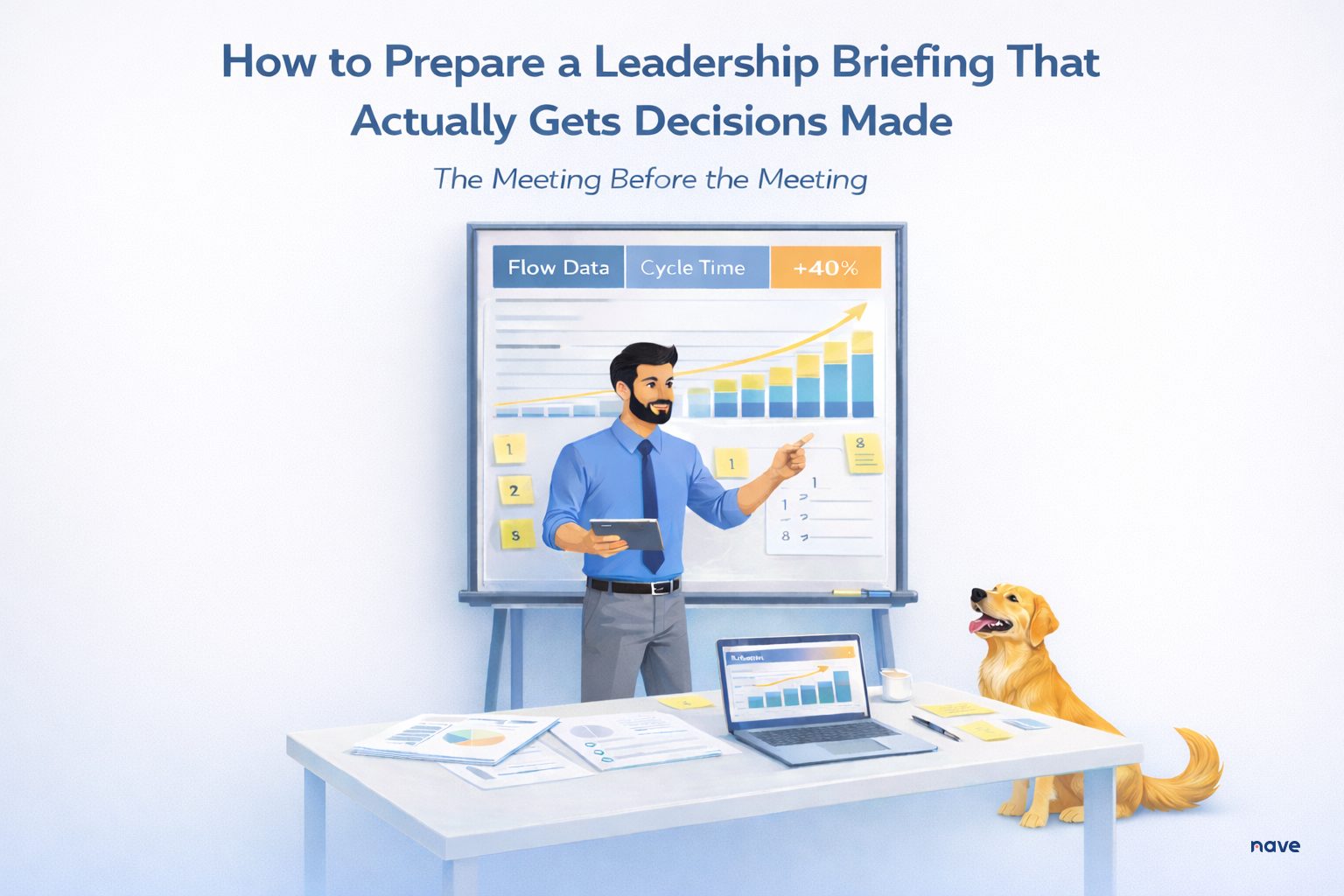
I once spent two weeks building a recommendation for a leadership team. Throughput data, cycle time analysis, bottleneck mapping, aging work items. The whole picture. I walked in confident that the evidence would carry the conversation.
The VP said “good insights” and moved on.
Ninety seconds. That’s how long my two weeks of preparation lasted in the actual meeting.
On the drive home, I kept replaying what went wrong. The data was solid. The analysis was right. The recommendation was clear.
And then it hit me. The meeting was never where the decision was going to happen. By the time that leadership team sat down together, every person at the table had already formed their position. They already knew what they’d support and what they’d push back on.
I had treated the presentation as the main event. The main event was everything that happened before anyone walked into that conference space.
The Decision Gets Made Before the Meeting Starts
Here’s the thing: every leader in that session arrived with a mental map of what they were willing to approve. The CTO had delivery dates on her mind. The product lead was thinking about feature commitments she’d already promised. The engineering VP was protecting his team’s workload because he’d approved the intake himself.
My recommendation hit each of these concerns differently. And I hadn’t accounted for any of them.
The coaches I’ve watched actually move organizations do something different. They already know which finding will land hardest with which leader. They’ve already anticipated the first objection. They’ve already sequenced their evidence so each piece earns the next.
They build the case around the objections, not around the data.
That’s what I now call the meeting before the meeting. The work of mapping your evidence to the specific people who need to hear it, in the sequence that makes each next step feel obvious.
Five Steps to Build a Briefing That Lands
I’ve turned this into a repeatable practice. Here’s how it works.
1. Name the decision, not the data.
What specifically do you need leadership to do? “Understand the bottleneck” is a presentation topic. “Pause intake into the deployment stage until WIP drops below 10” is a decision. Start with the action. Everything else gets built around it.
2. Map every person to their concern.
Write down who will be there. Next to each name, write the one thing they care about most. The CTO cares about delivery dates. The product lead cares about feature commitments. The CFO cares about the revenue impact of pausing work. Your recommendation will hit each of these differently. Know how before you walk in.
3. Identify the objection that will come first.
There’s always one person who will push back before anyone else speaks. You already know who it is. You probably already know what they’ll say. Build your opening around that objection. Show you’ve already accounted for it. The moment they realize their concern is part of your plan, something shifts.
4. Sequence your evidence so each finding earns the next.
Lead with the finding that’s hardest to dispute. A 26-day-old item stuck in one stage is a fact. Once that’s accepted, the arrival-vs-departure rate that explains it becomes a logical next step. Once the accumulation pattern is visible, the recommendation to pause intake is the obvious conclusion.
Each piece of evidence should make the next one feel inevitable.
5. Build the scenario they’re going to ask for.
Leadership acts on paths, not problems. “Here’s the bottleneck” gets a nod. “Here’s what happens if we clear it — and here’s what happens if we don’t” gets a decision. Build both futures before anyone asks.
Where This Becomes a Capability You Can Actually Use
I used to skip steps 4 and 5. The investigation required to trace a bottleneck through its downstream effects, map what happens to cycle time and throughput under two different scenarios, connect individual aging items to systemic constraints — that work was theoretically possible. In practice, coaching four teams and preparing for three meetings in the same week made it unreachable.
That constraint moved.
This is where Nave’s data and AI change what you can build in your preparation. The investigation is already done when you open the dashboard. The causal chain — which stage is accumulating, which items are stuck, how arrival rates compare to departure rates — is already traced. The evidence trail is already assembled and connected.
Your job becomes the human work. Step 2. Step 3. Step 5. Mapping what the data shows to who needs to hear it. Anticipating the pushback. Building the scenario that turns evidence into a path leadership can follow.
The AI handles the investigation. You handle the strategy for how it lands.
The Nave output becomes your briefing material. The cycle time analysis, the aging work breakdown, the bottleneck investigation — you walk into that meeting with the full evidence package already built. Your preparation shifts from assembling data to designing how it lands.
That combination makes the meeting before the meeting possible at a depth that wasn’t practical before. You can stress-test your own recommendation against real data. You can build the scenario that answers the CFO’s question before she asks it. You can sequence your evidence because the evidence is already there, already connected, already specific.
The data never lands in the meeting where you present it. It lands in the work you do before that meeting starts. Who hears what, in what order, with what evidence, against what objection.
That’s the skill. And it’s teachable. And it’s a choice you get to make every single time you prepare.
I’ll see you next week, same time and place. Bye for now!


“Name the decision, not the Data” – I am going to use this for a long long time going ahead. Such a wonderful one liner which encompasses loads of history and experience. Really good article, Sonya – thank you for sharing such a well written summary.
I’m glad it resonates ☺️