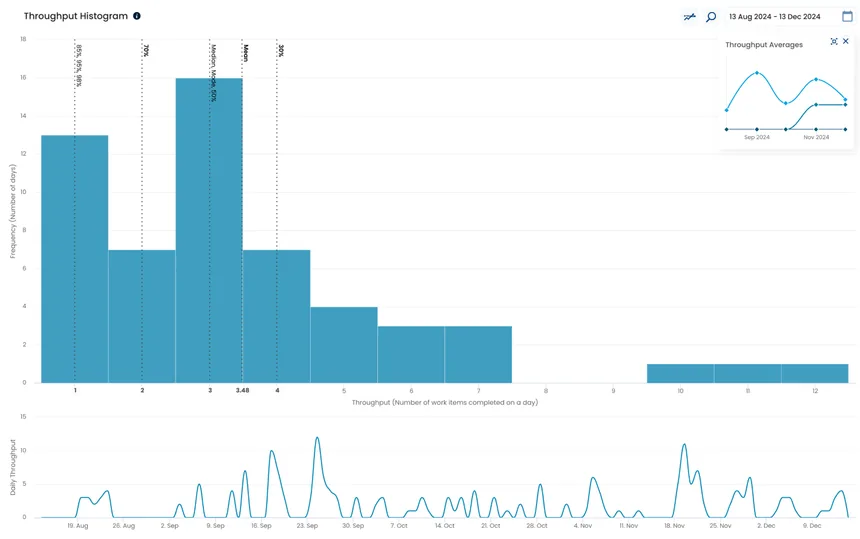
Throughput Histogram
Open the Throughput Histogram to support realistic goals and manage expectations. Use it with the run chart, which tracks progress over time and reveals trends.
What it answers
How much are we delivering?
See how much work your team completes over time and identify changes in delivery rate.
Example

Each bar’s colored sections represent the types of completed work.
The dotted green line uses polynomial regression to show how throughput has moved over the selected time period.
This widget shows which types of requests demand the most time. Each colored section shows a work type and its percentage of total completed work.
This widget shows the total work delivered in the selected time frame and how throughput rates have developed over time.
Throughput is the number of tasks delivered in a day, week, or month. The Throughput Run Chart shows your team’s throughput for the selected time frame.
The horizontal axis shows time, and the vertical axis shows throughput. Each bar uses colored sections to represent the types of completed work.
Monitor throughput weekly or bi-weekly to check that work is delivered in a stable and predictable way.

The dotted green line is the throughput trendline. It uses polynomial regression to show how throughput has moved over the selected time period.
A downward trendline means the team is struggling to deliver results. Review your work in progress, reduce your WIP limits, and focus the team on specific problem areas.

The ‘Throughput Breakdown’ widget above the graph shows which types of requests demand the most time. Each colored section represents a type of work and its percentage of total completed work.
Use the ‘Throughput Breakdown’ widget to emphasize a high volume of expedite requests.

The ‘Throughput’ widget shows the total work delivered within the selected time frame and how throughput rates have developed over time. Ideally, the line should remain even or increase smoothly.
Watch for decreases in the throughput line. They indicate bottlenecks that prevent the team from delivering consistently.

You can export the filtered data shown in this chart as a CSV.
Investigate a downward trendline because it can mean the team is struggling to deliver results. However, an individual dip is not always a sign of a problem.
Use the ‘Throughput Breakdown’ widget to identify and emphasize a high proportion of expedite requests.
When looking to improve overall team throughput, identify the slowest step and improve or eliminate that constraint.
Open the Throughput Histogram to support realistic goals and manage expectations. Use it with the run chart, which tracks progress over time and reveals trends.
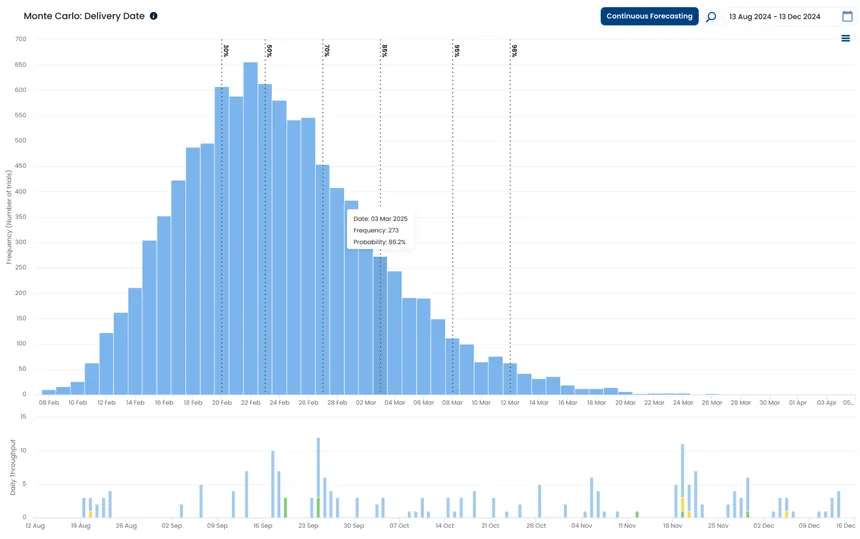
Open Monte Carlo: Delivery Date to present the most likely delivery date, along with optimistic and conservative outcomes, to stakeholders.
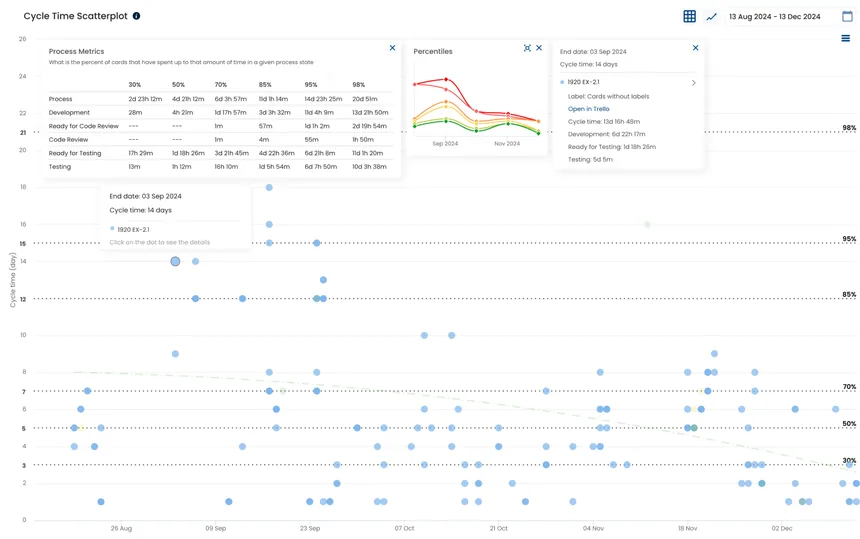
Open the Cycle Time Scatterplot to see outlier tasks.
Connect your existing delivery data and start exploring your flow.