Tell me if this sounds familiar.
The bonus review comes around and everyone’s performance metrics are collected. The numbers go into a spreadsheet. People are ranked from highest to lowest. The people at the top receive the bigger bonuses, while the people at the bottom leave the conversation with constructive feedback and a list of things they need to improve.
This approach is so common that most of us don’t even stop to question it. But I want you to pause for a moment and ask yourself something.
How does that ranking relate to the benefit each person brings to the business?
It doesn’t. And this is where the problem begins.
What Are You Actually Rewarding?
One of the principles I’ve believed in for a very long time is that people respond to what an organization values. And there is no stronger signal of what you value than what you reward.
When the size of someone’s bonus depends on where they sit compared with everyone else, you are turning performance into a competition. Your colleague’s improvement can now affect your own position. Helping someone else may improve the team’s result, but it could also help that person move ahead of you in the ranking. Sharing a practice that improved your own performance means giving away something that helped you succeed.
Can you see the conflict?
The business needs people to collaborate. The incentive gives each person a reason to protect their own result.
Now, I’m not saying that people immediately become selfish or stop supporting one another the moment you introduce an individual bonus. Most of these decisions don’t happen consciously. People simply begin paying more attention to the number that determines the reward.
And the moment a metric is linked to money, the metric itself starts changing. People make choices that improve the number. Those choices may look like better performance on the spreadsheet, but they will not always improve the business outcome the number was supposed to represent.
You’re probably thinking, “But Sonya, if we stop ranking people, what will keep them motivated to perform?”
I understand that question because I asked it too. Then we ran an experiment at Nave that completely changed the way I thought about incentives.
One Shared Goal Changed the Way Our Team Worked
A few years ago, we wanted to find out whether Nave could move to a four-day workweek. We didn’t simply reduce the working week and hope everything would work out. We gave ourselves three months and set one clear goal for the entire team. We wanted to deliver any work item in less than 15 days in 95% of the cases. If we achieved that goal, everyone would move to the four-day workweek.
It wasn’t one person’s target. It wasn’t the responsibility of the developers, the product team or the person who happened to own the work. The whole team shared the same outcome. And because everyone shared the outcome, the way they worked together started to change.
Every morning, the team opened our aging chart and checked whether any work item was entering the orange zone. The orange zone meant that the item had already spent more time in its current process state than 70% of the work we had completed in the past.
If nothing was at risk, there was nothing to discuss. We closed the meeting and everyone got back to work. But when an item started entering that zone, the conversation changed.
The team didn’t ask, “Who owns this?” They asked, “What do we need to do to move it?”
When the work was too complex, they temporarily reduced their work in progress and paired on it. When items kept stalling between process states, they introduced a clear definition of done for every step. When one person needed help, supporting that person improved everyone’s chance of reaching the goal.
That’s the whole point!
The team stopped looking at performance as a collection of individual results. They started managing delivery as a shared system.
And the results surprised even us. Three months later, 95% of our work items were finishing in less than eight days. We had aimed for less than 15. We moved to the four-day workweek.
Here is what the result looked like on our cycle time scatterplot:
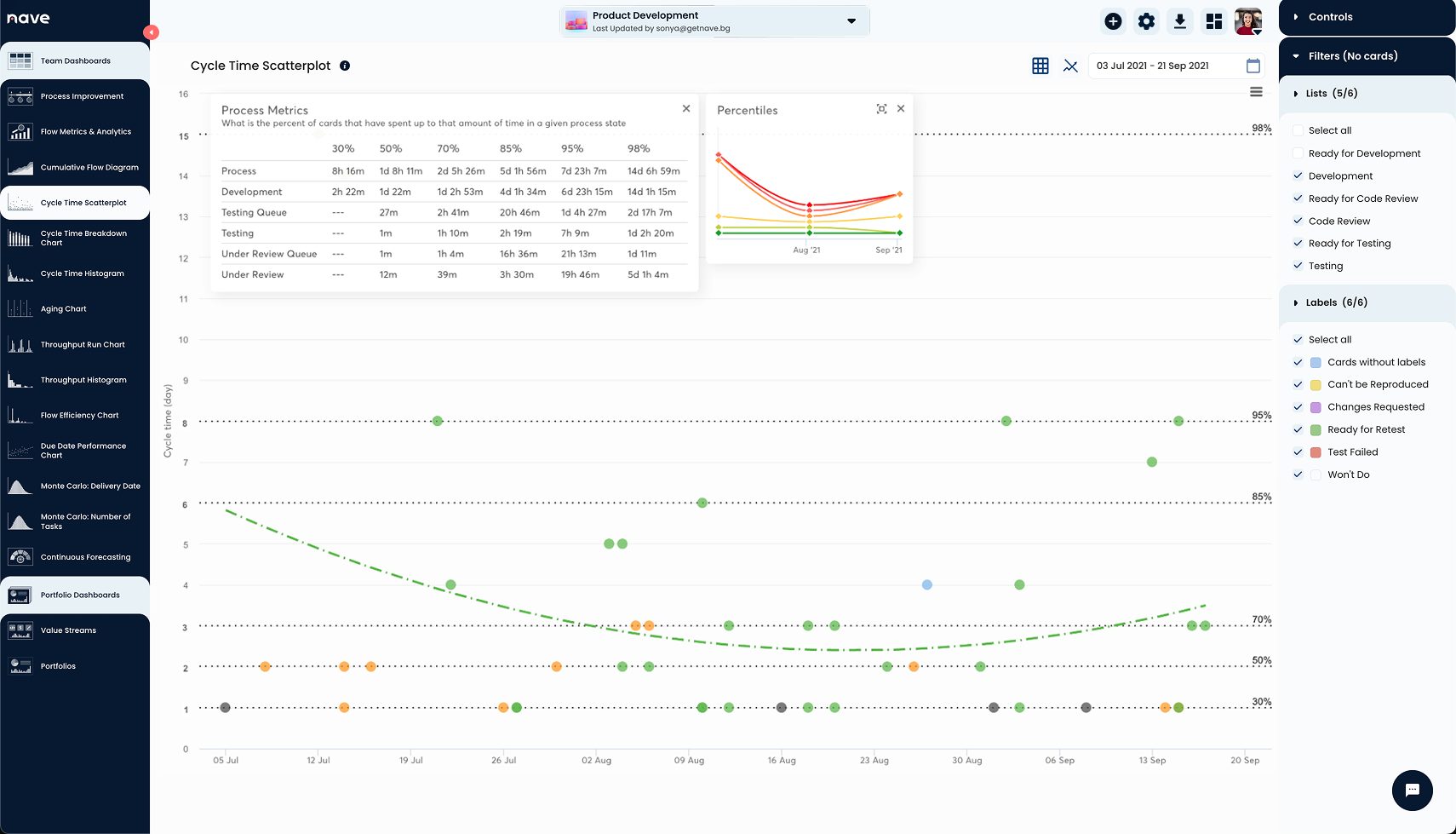
Our cycle time scatterplot at the end of the experiment. The 95th percentile line sits at eight days. In plain English, 95 out of every 100 work items finished in eight days or less. Learn more at getnave.com.
Nobody had to stand behind the team and push them to work harder. They could see the goal. They could see which work was putting it at risk. And they could act on it together.
Then We Changed the Compensation
After seeing what happened with the four-day workweek experiment, we applied the same principle to compensation. I am deeply committed to supporting our customers. That priority has always been incredibly important to me, but not everyone on the team saw it in exactly the same way. So we connected our strategic goals to each person’s goals and introduced a 10% profit-sharing model based on our collective success.
The business goal, the personal goals and the reward now pointed in the same direction. Support was no longer something that belonged to one role or one department. It became everyone’s mission.
Our customer satisfaction went up by 20%.
Take This Question Into Your Next Incentive Conversation
Before your next incentive discussion, I want you to take one question with you:
What behavior are we paying people to optimize?
Don’t start with the ranking. Don’t start with who should receive more and who should receive less. Start with the behavior the incentive will create.
If the bonus depends on an individual ranking, people will naturally pay attention to protecting their own position. If everyone shares the same outcome and the same reward, helping another person becomes part of achieving the result.
This doesn’t mean that you should ignore individual performance. When someone is genuinely struggling, you still need to have that conversation. You need to understand what is getting in their way and give them the support they need. But that is a support conversation. A ranking was never going to solve it.
Here is your action item. Before the next incentive cycle, write down the one business outcome you want the team to improve. Then ask yourself how you could reward everyone for improving it together.
You don’t need to redesign your entire compensation system tomorrow. Start with one shared goal. Run the experiment. Watch how the conversations change.
Because people will optimize whatever you pay them to optimize. Make sure the reward points them toward the outcome your business actually needs.
All right, my friend. I hope you found this helpful. I’ll see you next week, same time and place, for more managerial goodness. Bye for now!