I’m sitting in a status meeting, listening to three people describe the same initiative in three different ways.
One person believes the work is nearly finished. Someone else says it is blocked. A third knows about an urgent issue that has not made it onto the board yet. We open the board for clarity, only to discover outdated cards, completed work, and items that no longer reflect what the team is actually doing.
I’ve been in this situation more times than I care to admit.
When the board cannot answer a basic question about delivery status, people become the reporting system. Whoever was asked most recently provides the latest version of reality. As the organization grows, those versions multiply until nobody has a complete picture.
Visual management for delivery teams starts by correcting this problem. The status of the work needs to live in the system, not in people’s heads.
Why Your Board Is Not Yet a Shared Picture of Reality
Many teams technically have a Kanban board, but they use it as a storage space for tasks. Cards are added when someone remembers, moved when someone has time, and removed long after the work has finished.
That board may contain information, but it does not provide visibility.
A useful board should show the status of the work at any given moment. Every item the team is working on needs to appear there, and every card needs to sit in the state the work is actually in. If work has stopped, it should be marked as blocked. If an item is urgent, that urgency should be visible so the team knows how to handle it.
The workflow on the board must also be the actual workflow. A simplified sequence created for a report will not help people manage delivery if the work follows a different path in practice.
This is where status meetings often disguise the underlying problem. A team may believe it already shares this information because everyone provides an update in a meeting. But a meeting tells you what people remember, based on the part of the work they can see. It does not automatically create one reliable view across the whole delivery system.
The meeting should not be where you discover the status. The board should establish what is happening so the meeting can focus on what to do next.
Make the Current State of Every Work Item Visible
Start by treating the board as a communication mechanism rather than a to-do list.
Someone who understands the work should be able to open it and see what is in progress, what is waiting, what is blocked, and what needs urgent attention. They should not need to find the right person before they can interpret what they are looking at.
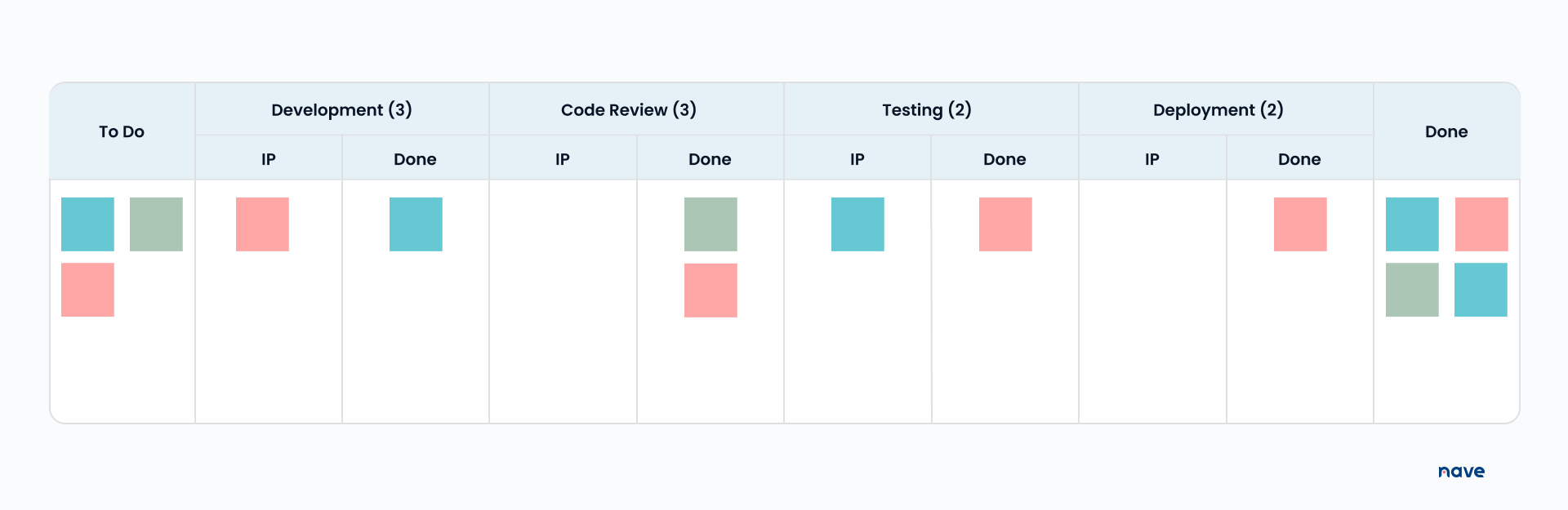
A readable workflow shows every step as a column and every work item in its current state, making blocked work, queues, and accumulating work visible without a separate explanation. Learn more at getnave.com
Once the board reflects reality, it begins surfacing management signals that conversations alone tend to hide. You can see work that has been sitting unresolved for too long. You can see where items are accumulating, which issues are at risk of delay, and which parts of the workflow repeatedly interrupt progress.
This visibility also creates a stronger feedback loop for improvement. Instead of entering a retrospective with competing opinions about what might be wrong, you can put one visible problem in front of the team. The team can form a hypothesis, agree on a change, and return to the same information at the next retrospective to see whether the situation improved, stayed the same, or became worse.
The experience of Eduardo Pinzon at Syngenta Digital shows what this method can enable. With the workflow and its performance data visible, his team could identify aging bugs, manage the risk of delay, and use past performance to answer when new issues were likely to be resolved.
The team removed 67% of the issues from its backlog and cut the average lifetime of bugs in half. Its data also showed that 85% of critical-priority bugs were fixed in less than three days. Those results did not begin with pressure to work faster. They began with enough visibility to focus on the right problems and test whether changes produced better outcomes.
As Eduardo put it, “Whether you acknowledge it or not, your workflow exists.” Making it visible gives the team something concrete to manage.
Test Whether Your Board Can Stand on Its Own
A board becomes a single source of truth only when everyone treats it that way. If people continue keeping important work in private notes, chat messages, or memory, the board will remain one incomplete version among many.
There is a simple way to see whether this is happening.
Tomorrow, pick one initiative currently in progress and ask three people who work with it to explain its status. Compare their answers, then open the board. If all four versions agree, your visualization is doing its job. If they differ, identify what is missing and put every item into the state it is actually in. Mark blocked work, show the queues, and make urgent items unmistakable.
Nave helps delivery teams visualize their workflow, identify aging work and outliers, examine workflow stability, and use past performance to support delivery decisions. You can explore it at getnave.com.
The status of the work should never depend on the person you happen to ask.
I’ll see you next week, same time and place for more managerial goodness. Bye for now!