Almost every delivery team I work with is pointing AI at the same place: the building. Developers adopt it, the coding genuinely speeds up, and there’s real excitement about it. The part everyone used to sweat, getting the thing built, starts to feel easy.
Then someone looks at how long work actually takes to reach a customer, and it takes just as long as it did before. Faster coding, same delivery. It’s one of the most common patterns I’m seeing right now, and it catches good teams by surprise, because the speed is real. It’s just landing on the part of the system that was never the bottleneck.
Why Faster Coding Doesn’t Reach the Customer
You don’t have to imagine where your delivery time goes. Your process is already mapped in Jira, in Azure DevOps, on whatever platform your team runs on. Look at the path a piece of work actually takes from “let’s do this” to “it’s live.” Some of that path is building. A lot of it isn’t. It’s waiting.
In most teams I’ve measured, the building was never the bottleneck. The waiting was. And here’s what happens when you drop AI into that picture: the building shrinks, but the approvals still take the same days they always did, the dependencies still sit in the same queues, and the deploy gate still opens on the same schedule. So the finished work piles up in front of those slow steps, and it piles up sooner than before. The queue gets longer. The bottleneck that was always there becomes impossible to ignore.
AI didn’t create that bottleneck. The bottleneck was there the entire time. It just became obvious faster, because now there’s more finished work waiting on it.
The Four Kinds of Waiting That Eat Your Delivery Time
When people picture “the work,” they picture someone building it. But for most of a work item’s life, nobody is touching it at all. It’s sitting in a queue, waiting on something. There are four kinds worth knowing, because each one forms for a different reason and gets fixed in a different way.
Approval waiting. The work is done and it’s waiting for a sign-off. A change board, a security review, a manager who’s in back-to-back meetings. The work didn’t get harder. It just needs a yes, and the yes is slow.
Dependency waiting. Your work can’t move until another team finishes the thing you depend on. Their priorities aren’t your priorities, so your finished work sits in their queue behind everything they care about more.
Deploy waiting. The work is ready to ship, but releases batch up. A weekly window, a release train, a freeze. The work is done for days before anyone is allowed to push it.
Decision waiting. Nobody has actually decided this is the priority. The work is technically ready, but it’s parked while the real question, whether this is the most important thing right now, goes unanswered.
Faster coding doesn’t shorten a single one of these. That’s why your customer waits just as long as they always did.
How to Find Your Real Constraint
You can do this with data you already have. Take all your completed items from the past three months and break their cycle time down by process state. It’s a simple split: how much of the total time the work spent in each step, from the moment it started to the moment it shipped.
What you’re looking for is the state with the longest segment. On most boards it’s a queue, a “ready for” or “done” column where work sits between steps rather than being worked on.
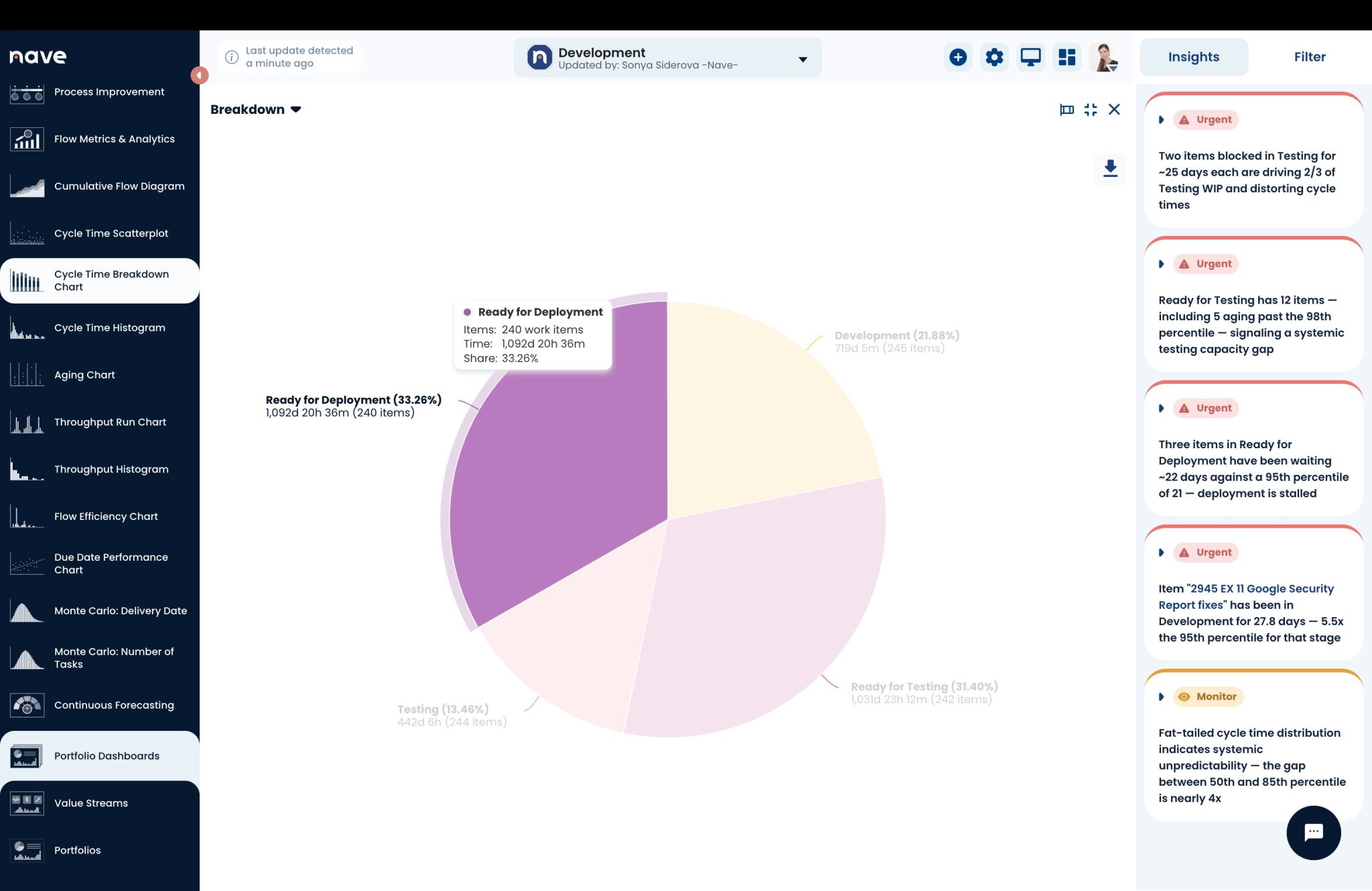
Cycle time breakdown in Nave. The two biggest slices, Ready for Deployment and Ready for Testing, are queues where the work just sits, together almost two thirds of the time. The building itself, Development, is about a fifth.
One thing trips people up here: a long queue state usually points downstream. If “Ready for Testing” is huge, the problem isn’t the ready-for column itself, it’s that the Testing step behind it can’t pull the work fast enough. The queue is the symptom. The next active step is the cause.
And watch it over time. If your longest segment is shrinking, your improvement efforts are working. If it’s growing, especially after you sped up the building with AI, that’s your proof that you optimized the part that was never slow.
What to Do About the Biggest Queue
Once you’ve found the queue eating the most time, the instinct is to throw more people at it. Allocate another tester, add another reviewer. That’s the most expensive move, and it should be the last one. Before you add capacity, get more out of the capacity you already have.
Start with policies. Look at the slowest step and ask what rule is making work pile up there. A review that needs two sign-offs when one would do. A deploy window that could open twice a week instead of once. Often the constraint is a policy nobody has revisited.
Then reallocate. If the people who own the bottleneck step are spending time on work someone else could handle, move that work off their plate so they can focus on the constraint. Idle capacity elsewhere can often go straight to the problem area.
Then cap the inflow. Put a tighter WIP limit on the active state next to the queue, so work stops pouring in faster than that step can clear it. Less work in progress at the bottleneck means each item moves through faster, not slower.
Only after you’ve exhausted those does allocating more people make sense. A single queue holding 20% of your cycle time is common, and resolving the step behind it can make delivery 20% faster on its own, without additional investment.
Aim AI at the Constraint
This is the shift. The organizations getting real value from AI aren’t the ones rolling it out the widest. They’re the ones who already knew where their bottleneck lived and aimed AI at that. If approvals are the constraint, the win is a faster approval, not faster code. If a dependency is the constraint, the win is unblocking the dependency. AI is a tool you aim, and aimed at the wrong step, it just produces a more obvious version of the same delay.
So before you celebrate faster building, confirm building was the problem. A cycle time breakdown shows you exactly where your delivery time goes, the active work and the pure waiting side by side, so the state that’s slowing you down stops hiding behind how busy everyone feels. It’s one of the views we built into Nave, and you can see your own at getnave.com.
Faster building is good. On its own, it isn’t a delivery improvement. It’s a spotlight. And the smartest thing you can do with a spotlight is look where it’s pointing.
I’ll see you next week, same time and place for more managerial goodness. Bye for now!