Your most capable person resigns. The one who carried the hardest work, covered the gaps, held the most context in their head. Within a week you can see exactly how much was resting on them, because everything they were holding stops moving.
I keep seeing the same pattern: when work is constantly pushed onto teams without a sense of flow, it leads to unrealistic expectations, burnout and, eventually, turnover. The most talented people are often the first to walk away, and with them goes critical knowledge and momentum. The result? A toxic cycle of overwork, poor outcomes, and broken trust.
And watch what happens next. The organization reaches for perks: a retention bonus, a title bump, another engagement survey. Then the system that wore down the last person gets to work on the next one.
Today I want to show you the three places that system leaves its fingerprints in your delivery data, weeks before any letter lands. But first, let me tell you how I know this pattern from the inside.
I Ran a System Like This
Back in the day, in my early years as a product manager, I believed every single thing being asked of us was important. Customer requests were constantly coming in. We were overpromising and underdelivering over and over again. I felt like we were always behind. I felt like I was always letting everyone down.
At the same time, we couldn’t really finish any of it, because we were constantly interrupting what we were doing to start the new request that had just arrived. I felt paralyzed by the overwhelm. It seemed like I was just going to stay stuck in that feeling, like there was literally no way out. One after another, my teams started to fall apart.
Do you know that feeling, when you’re frozen and can’t move forward? That’s your nervous system responding with fear and anxiety. If you’re not able to sleep properly, if your heart is racing, if you can’t take deep breaths, or you’re getting headaches, these are the signs that you’re under severe pressure, and that something needs to shift.
We’ve been brainwashed to believe our value is based on how busy we are. It’s not, and it never has been so.
Nobody on my teams lacked effort. What we lacked was a way to see the problem: when there are no systems in place, no clear understanding of the team’s actual capabilities, and no visibility into the demand coming from the market, reliable delivery commitments become impossible. We kept committing anyway. And the gap between what we promised and what we could actually finish landed on my people, every single week.
Retention Is a Flow Problem
You’re probably thinking, but Sonya, retention is HR’s problem. Pay, career paths, recognition. And HR can match an offer. What HR can’t fix is a delivery system that promises more than the team can finish, month after month.
Retention isn’t just about perks or pay. It’s about trust, respect, and appreciation. An overloaded system breaks all three, one impossible commitment at a time.
Here’s the thing: the overload leaves signals in your delivery data long before it shows up in a resignation letter. Three are worth checking this week.
Your starts against your finishes. Count how many items your team started over the last month, and how many they finished. When the starts keep outrunning the finishes, the difference doesn’t vanish. It piles up as work in progress, and work in progress sits on people: overburden, multitasking, context switching. On the cumulative flow diagram, this is the distance between two lines: the arrival line on top, and the departure line underneath.

The cumulative flow diagram makes the imbalance visible over time. From 23 May to 23 August, the arrival line is running at 1.44 items per day while the departure line is running at 1.20. That difference accumulates as work in progress. Learn more at getnave.com.
How many items each person is carrying. Count what’s in progress per person, and watch what happens when a new request arrives. Back then, we couldn’t finish anything because we were interrupting everything for whatever had just come in. If new work keeps jumping ahead of half-finished work, you’re watching the same cycle.
How long your ongoing work has been sitting. Open your aging chart. It shows every item in progress, placed at how long it’s been running, against percentile bands drawn from your finished work. When items sit far above in the red zone, you’re looking at work that aged artificially, because the system started more than it could finish. So the question is no longer who’s underperforming. The question now is how much work we’ve pushed into a system that can’t move it.
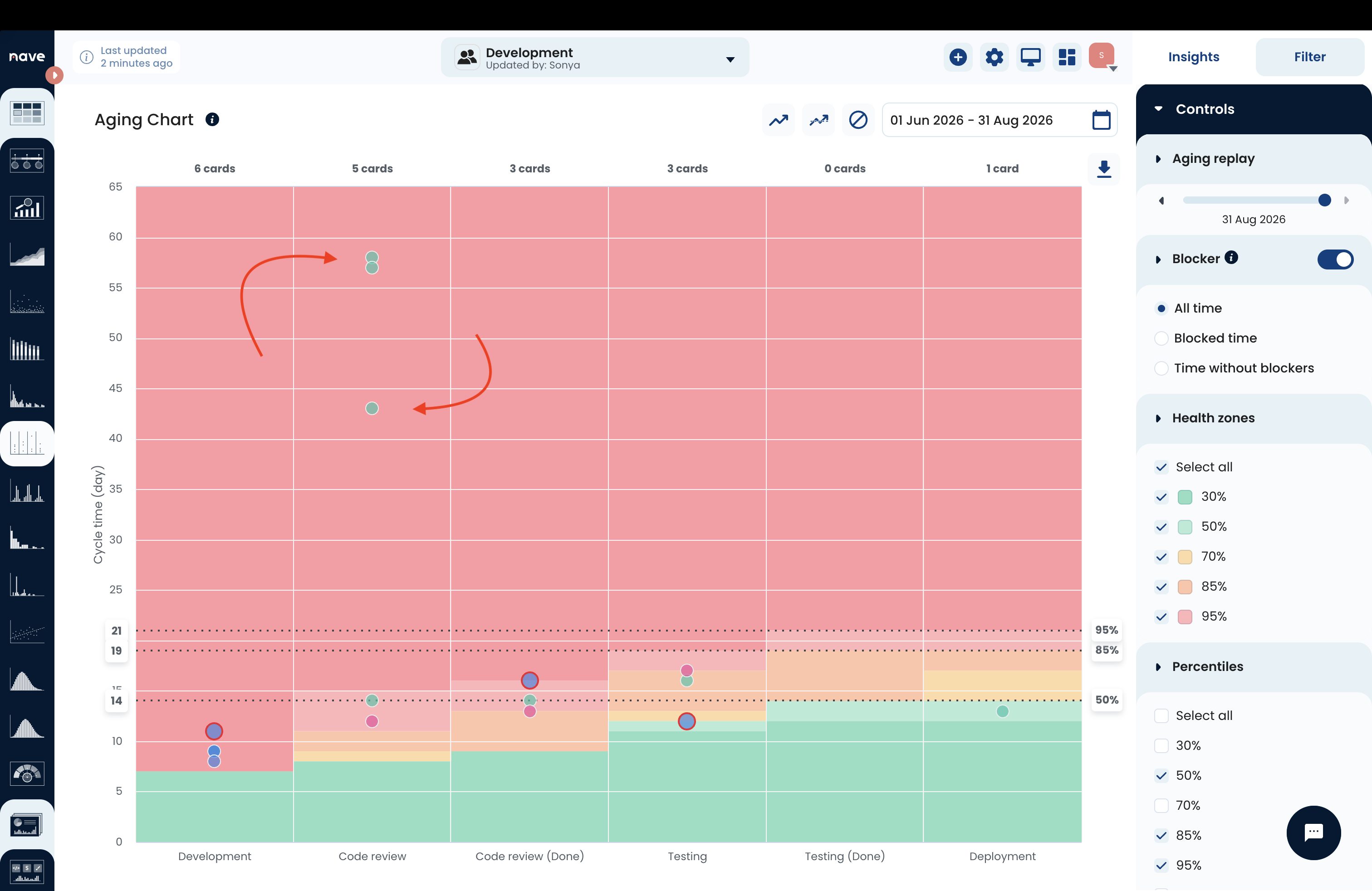
The 50th, 85th and 95th percentile lines sit at 14, 19 and 21 days. Three items in Code Review have already reached roughly 43, 57 and 58 days. Learn more at getnave.com.
Your Check for Tomorrow Morning
Here’s your action item: put your demand next to your capability for the last month. Count what came in and what got finished. Then bring those numbers to the people pushing the work.
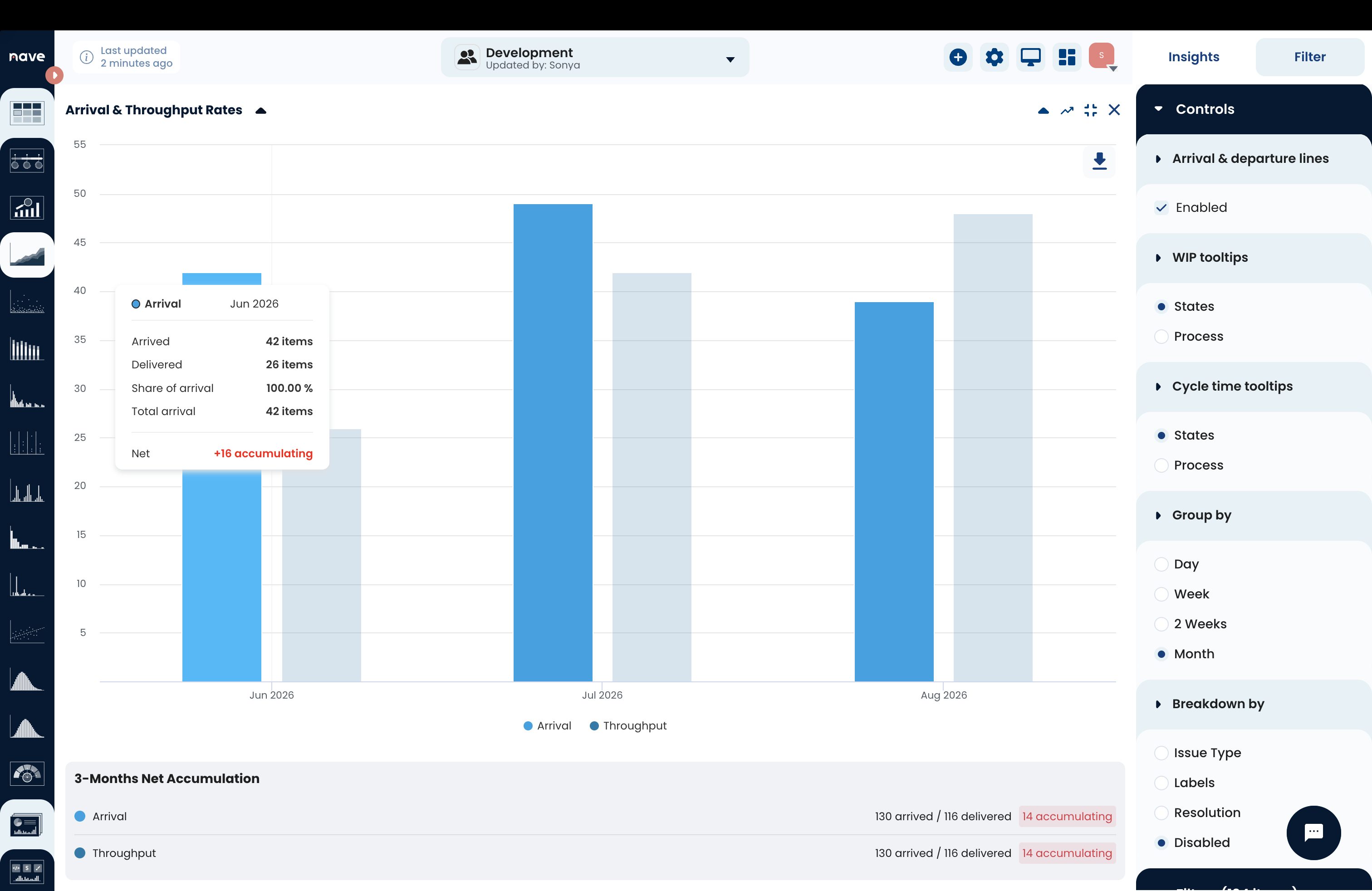
The monthly view shows the same mechanism in counts. In June, 42 items arrived and 26 were delivered: 16 items accumulated. Across the three months shown, 130 arrived and 116 were delivered, leaving 14 accumulating in the system. Learn more at getnave.com.
Because when your demand outstrips your capacity and you’re able to demonstrate that pushing new work actually leads to delayed deliveries, poor predictability and exhausted, overburdened teams, the conversation takes a totally different perspective.
No one can argue with numbers.
Book the fifteen minutes on your calendar now; if you don’t schedule it, you won’t get to it. And the three signals in this piece are one click away in Nave: your arrivals against your departures, your work in progress, and your aging items, updated every day. Learn more at getnave.com.
That conversation, repeated until the team can stop starting and start finishing, is the retention work. If we shift the focus from squeezing out more tasks to empowering people to do their best work, everything changes. Teams move faster. Results improve. People stay.
Thanks for tuning in! I’ll see you next week, same time and place for more managerial goodness. Bye for now!