Upstream Kanban: How to Handle Every Request Without Committing Too Early (and Put a Number on Your Yes)


A request lands in the middle of a meeting. Can your team take this one on? And you feel the knee-jerk reaction coming: sure thing, no problem!
We all want to be helpful. So we nod, say yes, and move the request straight into development, even when it’s not fully clear what’s actually needed. Then come the delays. Scope starts shifting. The date that felt safe when we said yes gets pushed once, then again. And the customer we wanted to keep happy is now the customer chasing us for updates.
I know this one from the inside. Early on I said yes to absolutely everything, and my teams and I only became that much more stressed and overwhelmed. Here’s the thing I had to learn: the timing of the yes decides whether the yes holds. The earlier you commit, the higher the chance of breaking that commitment.
Today I want to show you the upstream process that fixes this, the exact point where your yes should happen, and the number your yes can carry once it does.
Think of Your Upstream as a Funnel
In Kanban, everything before you commit lives in your upstream process. And the best way to picture your upstream is as a funnel: not all work items go through it. Some you commit to working on now, others you leave for later, and another type you discard altogether.
Discarding options is a feature, by the way! Feel free to drop options from your backlog when they’ve diminished in value. Your delivery workflow will always be the bottleneck of your system. Its capacity is limited, so you should choose wisely which work you initiate.
While a request sits in the funnel, it’s welcome, the conversation is happening, the work is being shaped and evaluated. And nobody has promised anything yet.
You’re probably thinking, but Sonya, saying yes IS the customer service. I get it. We all want to come across as tolerant, kind and polite. But your customers will only be happy if they receive what they’ve requested on time and of high quality. Starting more work rather than finishing old work leads to overburdening, less attention to detail and delayed delivery. An instant yes feels like great service in that conversation. The date that slips twice is what the customer remembers.
The Commitment Point: Where Your Yes Actually Happens
At the narrow end of the funnel sits the moment that changes everything: the commitment point. A commitment point is not the point when a customer request arrives. It is the moment when you and your team have gathered enough knowledge about the work to confidently say you’re ready to get started.
Let me give you an analogy from a very different part of life. My husband and I have been married for ten years and counting, and thanks to mutual respect and dedication, it’s a happy and stable marriage. Now imagine for a second that I had said “I do” without really understanding what I was signing up for. Committing to a relationship means you have realistic expectations for yourself, and that you’re able to deliver on your spouse’s expectations too. Managing work is not quite as romantic, but the commitment works exactly the same way.
That’s why crossing the commitment point is a two-way confirmation. The business side confirms the work is understood, the risks are known and it’s worth the investment. The team confirms they understand the work and have the capacity to begin. Nobody promises alone.
So, has your client given you a request? Yes. Has your lead time begun? No. Your lead time doesn’t begin when your client requests the work. It starts when you commit to doing the work. Before that moment, everything is optional. After that, the countdown begins. And you decide where that point sits: it’s your process, your commitment point.
Where One Team Drew the Line
Let me show you what this looks like on a working board. This team manages their upstream and delivery process on one board. Requests land in Options. The ones that fit the strategy move to Good Options, where the work gets evaluated: risks, acceptance criteria, a clearly defined scope. Then an item moves to Next Options, a column that means one thing: this work is ready to be pulled.
There’s no weekly meeting where a batch of items gets picked for development. The team pulls an item from Next Options the moment they have the capacity to start new work. That pull, from Next Options into Development, is the commitment point.
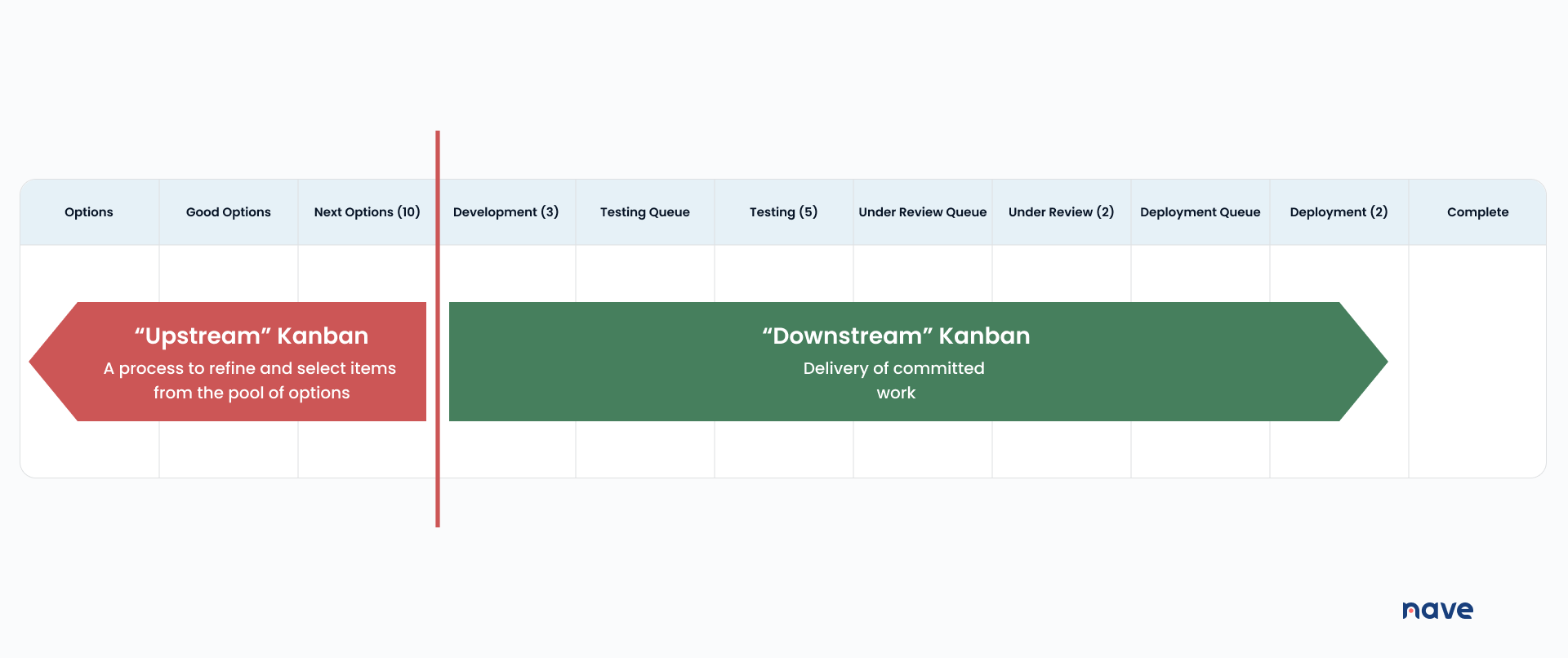
The team’s board. Everything left of the line is optional. Pulling an item from Next Options into Development is the act of committing.
And here’s what that line buys you. Because the clock starts at the commitment point, this team can open their cycle time scatterplot and read off what their yes is worth. On their chart, the 85th percentile points to 11 days: they will finish the work in less than 11 days with an 85% chance of keeping that promise. And when a stakeholder needs more certainty, the commitment of finishing a work item in less than 15 days comes with 95% certainty.
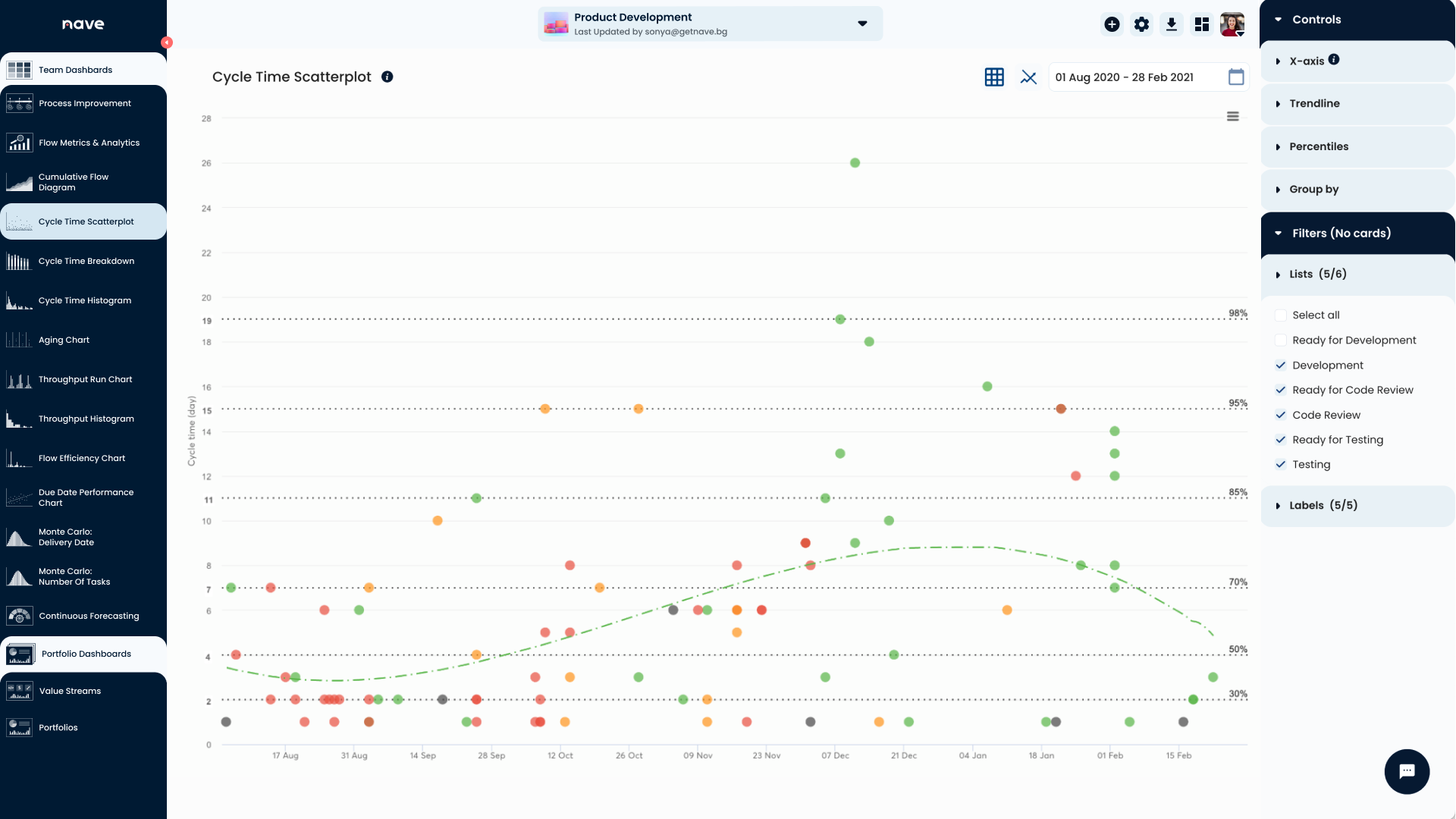
The team’s cycle time scatterplot in Nave, with the upstream steps filtered out. The 85th percentile sits at 11 days, the 95th at 15. Learn more at getnave.com.
The question is no longer when you’ll be done. The question now is how much risk are you willing to take? Either way, the answer to “can your team take this one on” stops being a reflex and becomes a promise with a probability attached.
Draw Your Commitment Point Tomorrow Morning
Here’s your action item: get your team in front of the board tomorrow morning and draw your commitment point. One line, at the exact column boundary where work stops being optional. Then write down, right next to the board, what crossing that line means: the business side confirms the work is understood, the risks are known and it’s worth the investment; the team confirms they understand the work and have the capacity to begin. Make it clear that moving work items through that point is an act of committing to delivering these items. Book the session on your calendar now; if you don’t schedule it, you won’t get to it.
The scatterplot in this piece is Nave’s: filter out your upstream steps, and the percentile lines tell you exactly what your yes is worth. Learn more at getnave.com.
The next time a request lands in the middle of a meeting, you don’t have to answer on the spot. Keep the work optional until your team can confidently say yes. That’s how you protect your team’s focus and meet your customer’s expectations.
Thanks for tuning in! I’ll see you next week, same time and place for more managerial goodness. Bye for now!