
Take two snapshots of the same team, three weeks apart, and they can look completely different.
In the first snapshot, every column on the board is full. Testing has a queue it cannot clear, a delivery date is at risk, and leadership is wondering whether the team needs a contractor.
In the second snapshot, the board is thin. Half the team is waiting for work, and leadership is asking why so many people have nothing to do.
These snapshots can appear to show two separate staffing problems. One week, the team appears to have too little capacity. Three weeks later, the same team appears to have too much.
Here’s the thing: neither week tells you the team’s capacity on its own. Both weeks can be part of the same uneven delivery pattern.
Lean calls this unevenness Mura. It describes a feast and famine cycle in which periods of overburden alternate with periods of waiting. To smooth delivery throughput, you need to examine how work enters and moves through your workflow before making staffing decisions based on a single week.
The Busy Week Creates the Idle Week
When work enters your delivery system as one large batch, it continues moving through the system as one large batch.
The items reach the same process stage together and exceed its capacity. A queue builds before the constrained stage. Everything upstream begins to accumulate, while the activities downstream wait for something to arrive.
Once the constrained stage clears the batch, the items move forward together. The downstream activities become busy, the upstream queue disappears, and the workflow eventually empties. Then the next batch enters and the cycle starts again.
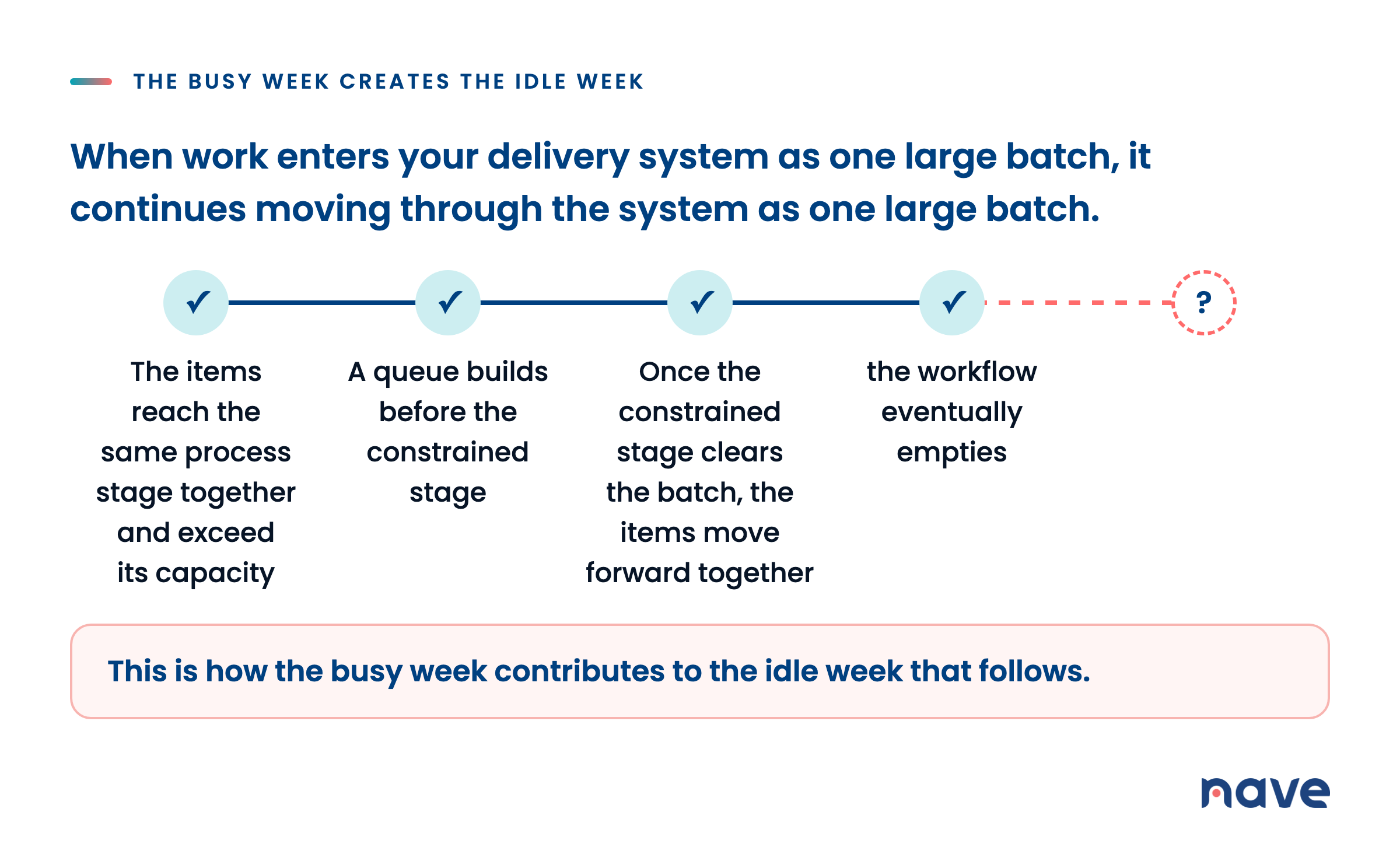
This is how the busy week contributes to the idle week that follows. The overloaded part of the cycle produces shortcuts, defects, and burnout. The other part produces waiting. If you treat either week as an independent staffing signal, you miss the connection between them.
Throughput shows how many items your team finishes during a chosen period. Looking at the distribution of those completion counts helps you understand how much the results vary.
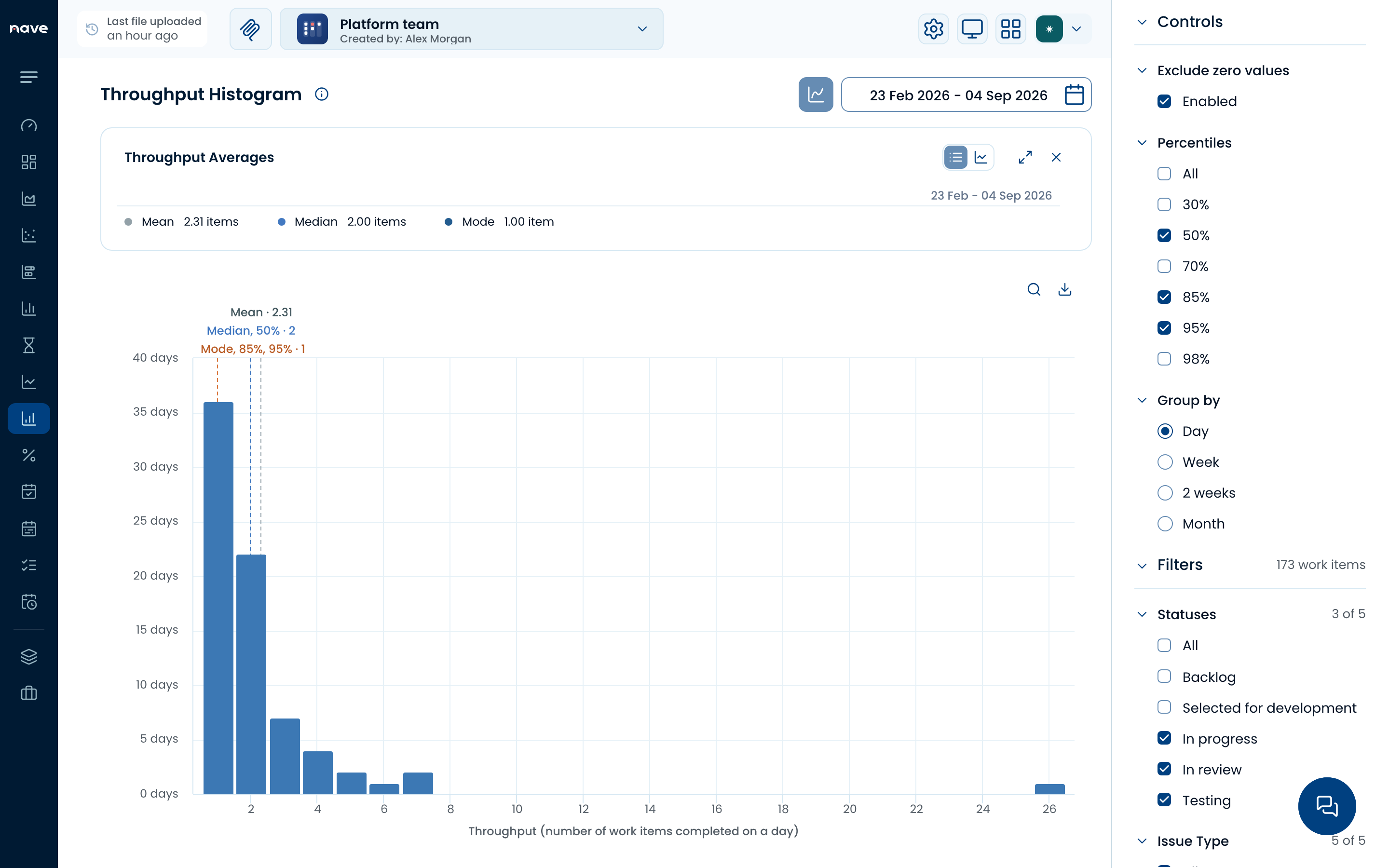
The Throughput Histogram page in Nave for 23 Feb to 04 Sep 2026, grouped by day, with “Exclude zero values” on. One item finished on 36 days, two items on 22 days, three on 7 days, four on 4 days, five on 2 days, six on 1 day, seven on 2 days, and 26 items on 1 day. Nothing finished between 8 and 25 times on an included day. The Throughput Averages card shows a mean of 2.31 items, a median of 2.00 items, and a mode of 1.00 item.
This histogram includes one day with 26 finished items. Every other included day has seven or fewer. The chart shows the size and frequency of the completion counts, but it does not show where the work waited or how it moved through the process.
To understand what caused the uneven throughput pattern, connect those completion counts to what happened in your workflow. The question is not whether your team can finish many items on one occasion. The question is how evenly your process allows the work to move.
Let the Backlog Absorb Uneven Demand
Customer demand may arrive in waves. Requests can accumulate at the end of a quarter or during a budget period. An escalation can also arrive without warning. You cannot make those requests appear at an even rate.
However, a request arriving and your team starting that request are two different events. Your customers determine when requests arrive. Your process determines when those requests enter the delivery workflow.
Keep your long-term direction expressed as goals instead of planning every task months in advance. As requests arrive, turn the requests that support those goals into work items. Prioritize those items and place them in the backlog.
The backlog can absorb the uneven demand while your team pulls work into the delivery workflow at a steady pace.
Two rules protect that pace. First, set a work in progress limit so that a new item enters a process stage only when an outstanding item moves forward. Second, define an explicit pull policy so that items leave each process stage in the same order in which they entered it.
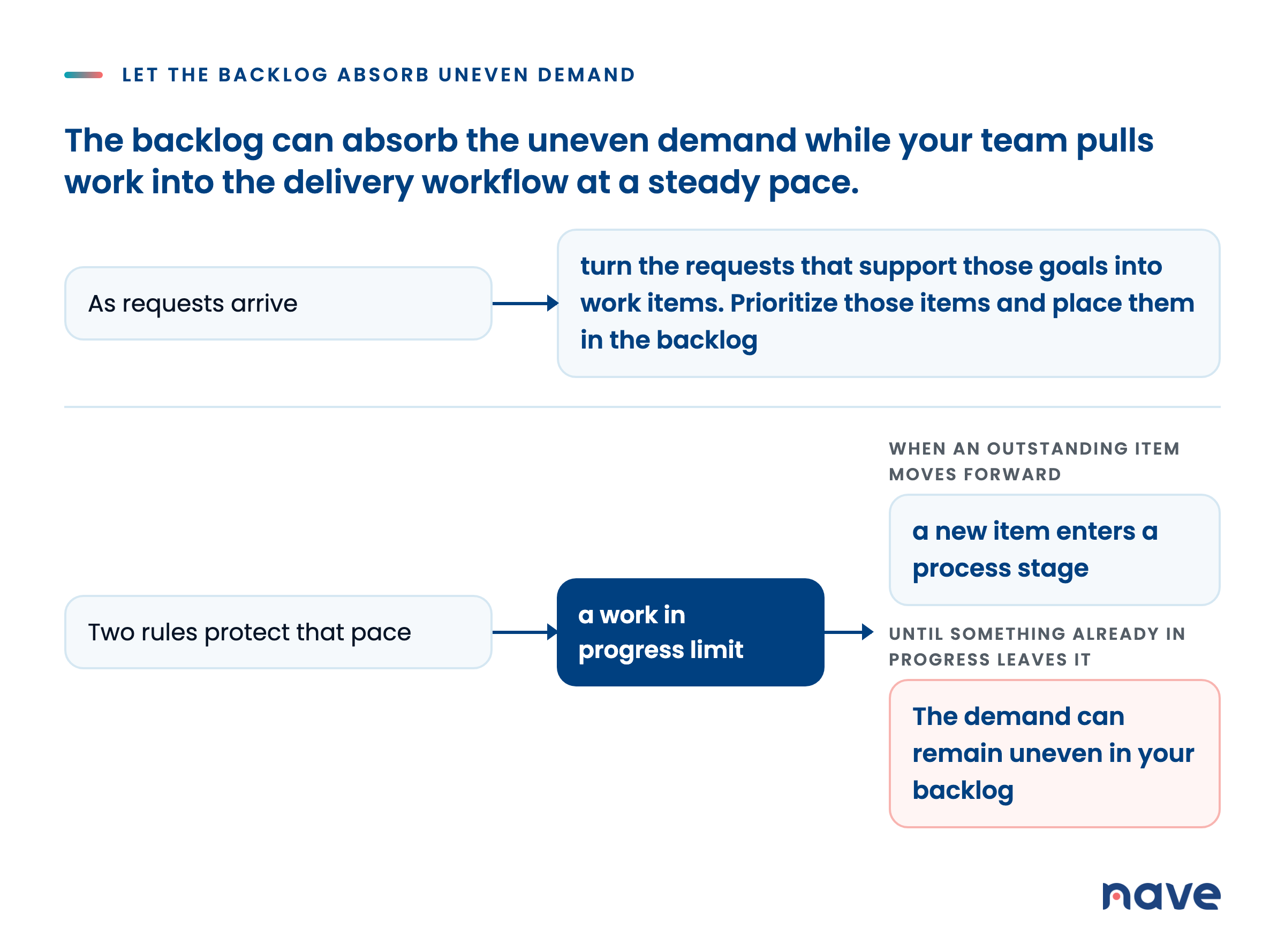
This order prevents quick items from repeatedly passing more complex items while the complex work continues to age. The demand can remain uneven in your backlog without forcing your delivery workflow to follow the same pattern.
Choose One Policy From Your Throughput Pattern
Start with your weekly throughput for the last quarter. You will have thirteen completion counts. Compare the week with the most finished items against the week with the fewest, then connect that swing to the way your work moved.
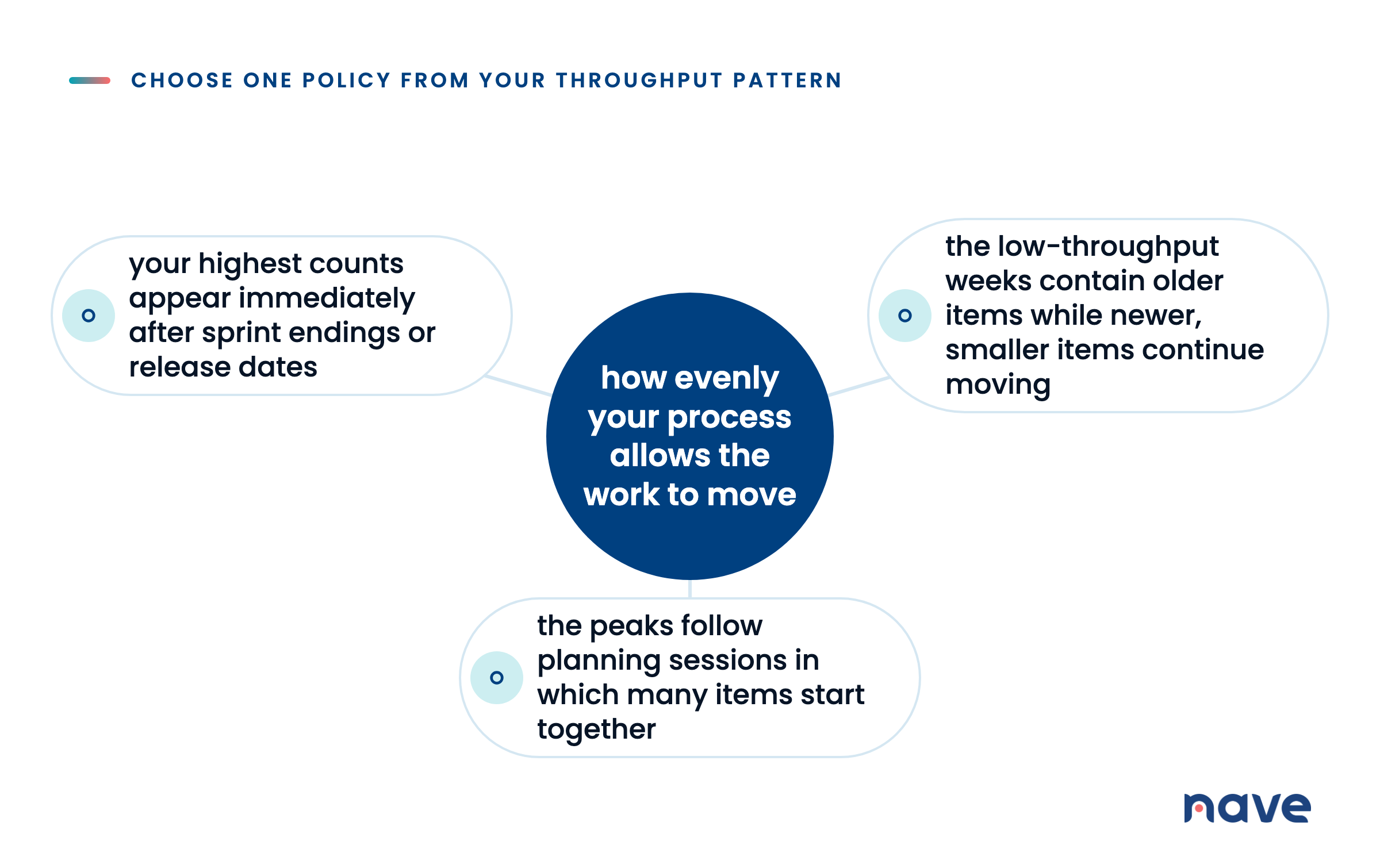
If your highest counts appear immediately after sprint endings or release dates, allow finished work to move forward as soon as it is ready, one item at a time. Don’t hold finished items until a scheduled boundary.
If the low-throughput weeks contain older items while newer, smaller items continue moving, make the oldest item in progress move first.
If the peaks follow planning sessions in which many items start together, stop new work from entering the workflow until something already in progress leaves it.
Choose one policy that addresses the pattern in your data. Write it down with your team and display it where people pull work. Keep that policy in place for one month. Then review your throughput again and check whether the difference between your highest and lowest weeks has narrowed.
Here is your action item: Tomorrow, pull your weekly throughput for the last quarter and write down all thirteen values. Find the difference between your busiest and emptiest weeks. Then choose the one pull policy that addresses the pattern you find.
Evaluating that policy depends on seeing whether your workflow becomes more stable. Nave helps delivery teams visualize their workflow, identify aging work and outliers, examine workflow stability, and use past performance to support delivery decisions. Learn more at getnave.com.
Your customers may arrive in waves, but your delivery workflow does not have to move in waves with them.
I’ll see you next week, same time and place for more managerial goodness. Bye for now!